
Throttle Link is about people and the machines that bring them together, so I’ll start with a confession: the first Bugatti I ever saw in person belonged to Canelo Álvarez. He pulled up in it at a private gated community, after a DGR weekend in Mexico City with Jaime Camil and Ricardo Salinas. That’s also the day he told me no.
It was a polite no, and a fair one. To explain how it became a yes, and how I ended up in a ring in the mountains with Jaime counting down to the interview, I have to start in Mexico City.
It started with a ride
This story begins at the Distinguished Gentleman’s Ride in Mexico City, with my brother Jaime Camil and with Ricardo Salinas. That weekend was about motorcycles and men’s health, and it brought together people I never expected to sit across from.
Then the plans changed. A flight change sent us to Tijuana, and from there to a private gated community. I’m keeping the where and the who to myself. Some places stay private for a reason.
That’s where I met Canelo, the day he arrived in that Bugatti.
When the podcast came up, he turned me down, and he explained why. He has a rule: no media for 30 days after a fight. He wasn’t brushing me off. It was a standard he holds himself to, and I respected it. I’ve come to see it as the first thing he taught me about how he works.
“How ghetto”
The yes came later, thanks to a personal invite through Jaime. In mid-August 2024, about a month before Canelo defended his super middleweight titles against Edgar Berlanga in Las Vegas, Jaime and I flew out of Burbank on Southwest, headed for Reno.


I booked it. It was Jaime’s first Southwest flight ever. When he figured out there were no assigned seats, he looked at me and said it: “How ghetto.”

As soon as we landed in Reno, we ran into Team Canelo fans who insisted on giving us a ride. We insisted on not getting in the car. You can guess how that ended: we got in the car. Our first ride of the trip came from his fans.

From Reno, the road climbs into the Sierra toward Truckee, at about 5,800 feet. The air thins with every mile.


A camp that feels like a home
I spent three days in camp. What hit me first was the atmosphere. Everyone was training. His kids and family were there. Nobody was yelling, and nobody was performing for a camera. I told him so when we sat down: watching him, you think, this guy is a monster. Fast, super powerful. At the same time, he’s aware of everything happening around him.
He gave the credit to the people. “We’re enjoying it, each of us in our own field,” he told me. “Everyone here has their job, and everyone enjoys their job. I enjoy my work. We train at 100%, but at the same time we’re enjoying it.”
Then came the line I keep coming back to: “That’s why I always say this isn’t hard for me, because I love what I do. That doesn’t mean it’s easy.”
In Spanish, it lands even cleaner: «Para mí no es difícil esto porque amo lo que hago… no quiere decir que sea fácil.»
“This isn’t hard for me, because I love what I do. That doesn’t mean it’s easy.”
In the gym, I did what I always do: grab my shots and look busy. At one point his trainer paid me a compliment. In a room full of people who do this at the highest level, that meant a lot.

There’s a heavy bag in that gym, a big teal one that reads “No Boxing, No Life.” The phrase is his mantra. It’s tattooed on his left bicep, and it’s also the gear brand his team built. He first wore those gloves in the ring against Rocky Fielding in 2018. Even the nickname is part of the story. Canelo means cinnamon, and he got it mostly for his red hair. His first trainer started calling him “Canelito” when he was 12 or 13, and his freckles played a part, too.


“Termina”
He notices everything. I learned that on the first night.
After the gym work, we went upstairs for cardio. His group was on the treadmills, and I was on the StairMaster. They finished and started to leave, and I still had three minutes to go. He asked how much I had left. Three minutes.
“Termina,” he said. Finish.
I was embarrassed. But they waited, the whole group, until I was done.
The next day, a sugar-free Red Bull was sitting out, and I asked whose it was. Canelo was deep in his own work, in his own world, or so I thought. Without missing a beat, he said, “No, take it.”
When I brought up both moments in the interview, he treated them as nothing special. “It’s normal. It’s part of me. I do it unconsciously,” he said. “It’s part of my essence. It’s part of who I am.”
“People have always told me that, that I’m on top of everything,” he added. “Even when I’m training or sparring, if someone says something, I know it.”
I asked whether that gets exhausting. “No, not at all,” he said. “Honestly, I’m very relaxed.”
“Did you bring your camera?”
The night before the interview, we had dinner at the house. Walking out afterward, I said it out loud: what a beautiful, comfortable environment he has built.
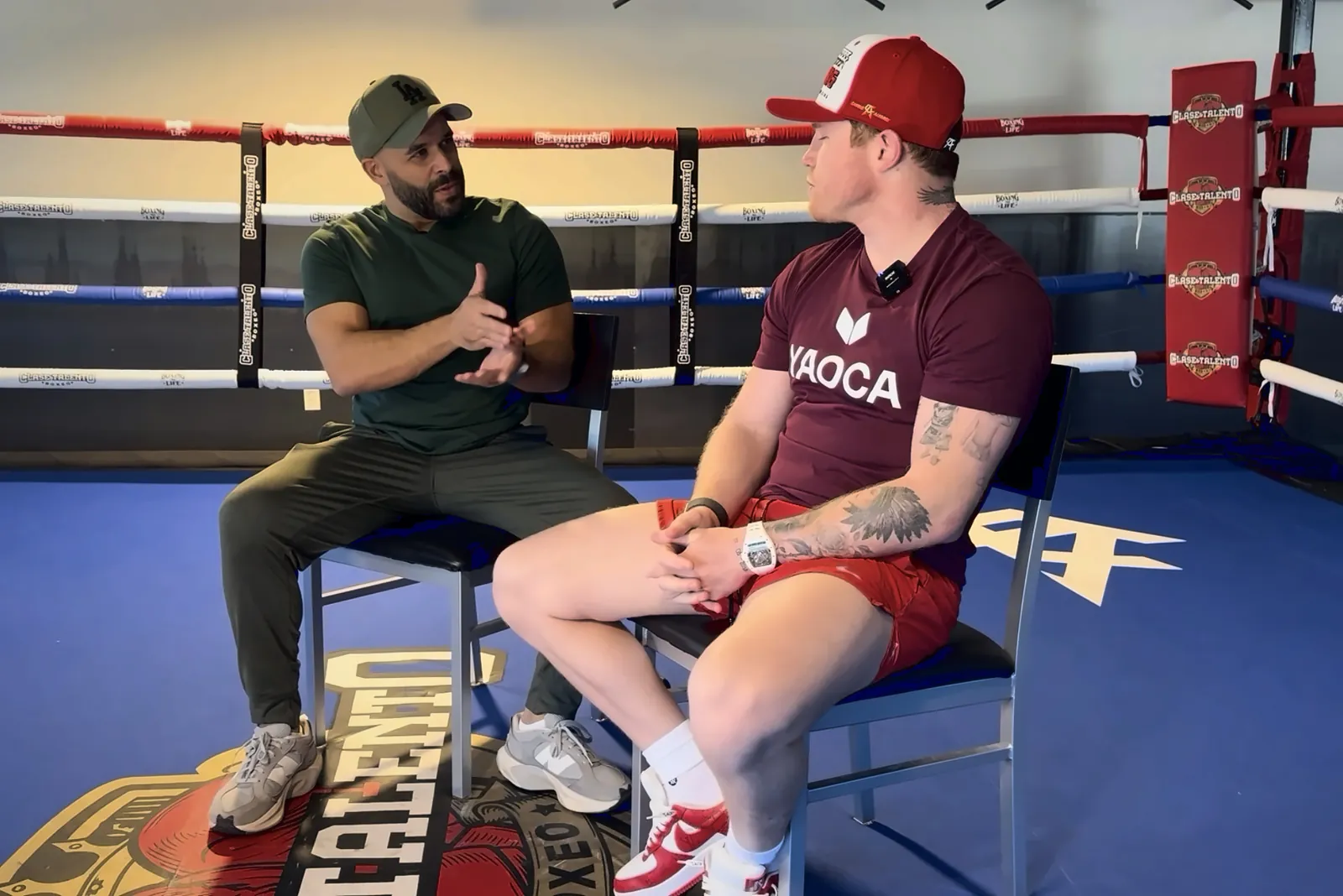
On the third day, after training and right before our flight, it happened. Canelo looked at me and asked, “Did you bring your camera?” Then he went to change.
We set up in the ring. Jaime took his place and counted us in like a director on a film set: three, two, one. Then he finished with a line I can’t improve on: “¡Toma uno, putos!” Take one. And we were rolling.
Before the camps, there was a job
I asked whether it had always been like this. It hadn’t. “Before, they weren’t really camps,” he said. “We didn’t have the money to go somewhere to focus. It was from my house to training. I used to work and train at the same time.” Even then, he told me, he was “always trying to train at 100%, wherever I was and however I could.”
The compound in the mountains is new. The standard isn’t.
The team of five
I asked about the biggest change since those early days. He talked instead about what hasn’t changed. “The team has always been the team,” he said. “Very, very, very tight. There are always five of us, normally, in camp.”
What has changed, he said, is experience: “With more experience, I think I enjoy it even more.”
Life after the bell
Everyone knows the boxing résumé. I wanted to hear about the businesses, which he says he learned from examples in his family and among friends.
“It’s what I’m going to enjoy when boxing ends,” he said. “It’s what I’ll be focused on, and it’s what will keep up the quality of life I have today.”
I brought up how many fighters earn fortunes and end up with nothing. He didn’t hesitate. “Usually the athlete retires and keeps spending the same as when he was fighting and earning that big income,” he said. “So in the end, the money runs out if you don’t invest it, or if you don’t invest it well.”
At peace
He’s a family man with an incredible record and successful businesses, and the haters still come for him. I asked why.
“I don’t know,” he said, “but I wouldn’t want to understand it either.” He used to pay attention, back when “everything was new,” but he learned it does more harm than good. “Instead of helping you, it hurts you.”
Then came the answer that told me everything about where he is: “I’m good. I’m happy with what I’ve done. I feel calm. I feel at peace with what I’ve done.” «Me siento en paz con lo que he hecho.» “I feel fulfilled, and I still want to keep winning.”
Round by round
Over those three days, I noticed that he and his team live in the present. I asked where that comes from.
“Experience, practice, the experiences we’ve had,” he said. “For a while now, I live day to day. In the gym, round by round. I tell myself, I’m going to work this round as if it were the first.”
“In the gym, round by round. I’m going to work this round as if it were the first.”
Run with wolves
For anyone entering the sport, his advice started with love: “That they love what they do.” Then he quoted a saying: “Without talent, don’t go looking for greatness.” We all have a talent, he told me. You have to find it, love it, embrace it and enjoy it, whether you’re a lawyer, an athlete or a salesman.
I pushed further: you also have to control your environment, right? He reached for an old proverb: si con lobos te juntas, a aullar te enseñas. Run with wolves and you learn to howl. “The environment you’re in influences you a lot,” he said. “So look for somewhere you feel comfortable and happy, and there you’ll be fine.”
People have come and gone, he admitted. “You also have to learn to live with the darkness, and know how to embrace it and live with it.”
Two years later
Before we wrapped, he asked his fans to show up on September 14 and enjoy a great fight. The episode went live the day before, on September 13, 2024, and the next night in Las Vegas he beat Berlanga by unanimous decision.
With Canelo back in the ring on October 31 against Christian Mbilli for the WBC super middleweight title, live on DAZN pay-per-view, it felt like the right time to go back to that conversation. Different camp, different opponent. I’d bet the formula hasn’t changed: the same small team, the same standard, one round at a time.
It started with a no and a 30-day rule. It ended with “did you bring your camera?” In between, I met a man who loves the work, trusts his people, notices everything and is at peace with who he is. Whatever happens on Halloween night, that’s the champ I’ll be watching.
Watch the conversation
- Spanish: Tres días con el campeón: Dentro del campamento de entrenamiento de Canelo Álvarez
- English title: RB-EP143 | Three Days with the Champ: Inside Canelo Alvarez’s Fight Camp
The interview is in Spanish; all translations are mine. The episode posted September 13, 2024, the day before the Berlanga fight. The travel vlog went up on September 10 and a sneak-peek clip on September 14.